
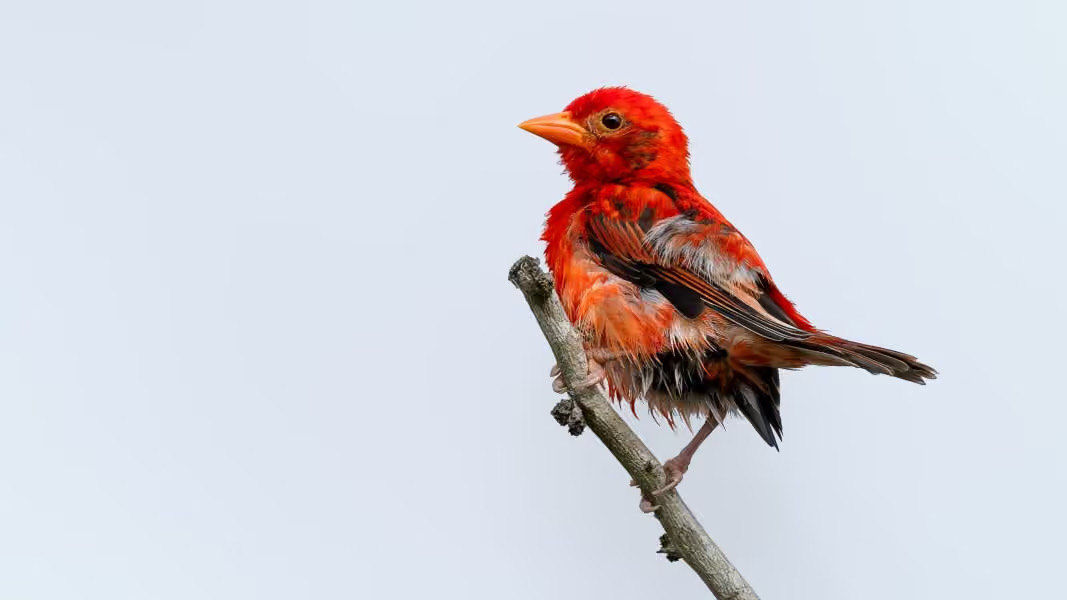
Three flashes of red broke from a bush, and a decade-old mystery was solved.
On the morning of July 3, 2026, two Kenyan birders shouted “Our birds!” deep in Boni-Dodori Forest, Lamu County.
James Apolloh Omenya and Simon Odhiambo had just rediscovered the Red Weaver, a species not documented since 2014.
The find puts a remote patch of Kenyan forest firmly on the world’s conservation map.
11-Day Search
The rediscovery followed an 11-day expedition through land that is both ecologically rich and heavily secured.
Omenya and Odhiambo covered miles on motorbike, chasing a bird whose habitat sits near the Somali border, an area rarely surveyed by researchers because of security concerns.
Odhiambo, a Murang’a-based conservationist known as The KenyanBirder and a senior executive at Kakuzi Plc, called the moment thrilling.
He explained that the Red Weaver exists only in this one forest globally, and that it had gone unseen for more than a decade before their trip.
Omenya, 29, is a professional ornithologist and bird guide. He is one of five recipients of the 2026 Ornis Birding x Lost Birds Expedition Grants, which supports young birders aged 18 to 30 in tracking down lost species.
He picked two targets for this trip: the Red Weaver, whose earlier search had been cut short by security risks, and the Tana River Cisticola, unrecorded since 1967. Both birds occupy overlapping range in Kenya’s remote northeast.
Part of the reason the Red Weaver vanished from records for over a decade comes down to classification, not just scarcity.
For more than a century, scientists filed it as a subspecies of the Red-headed Weaver rather than its own species.
That changed only in 2024, when eBird recognised it as distinct. By 2025, it had already landed on the Lost Birds list. Before this expedition, the Search for Lost Birds portal had only one photographic record of the species, taken by John Musina in April 2014, in the same forest.
Team Effort
Omenya led a team that blended science, local knowledge, and logistics.
Bird photographer Odhiambo worked alongside environmentalist Dr Victor Ikawa and Paul Kaberere of the Environmental Compliance Institute. Tour guides James Mburu and John Gitiri, motorcycle riders Mohammed Noor and Charles Manhala of Aweer Conservancy, and driver Caleb helped the team navigate difficult terrain.
Their safety depended on a wider network too: Chiefs, county commissioners, village elders, and armed escorts supported the expedition, with the Kenya Defence Forces providing protection in areas exposed to militant activity.
That kind of coordinated backing may be exactly what keeps the story of this species from going quiet again.