
Kenya Power is urging a more cautious, balanced approach to integrating variable renewable energy (VRE) sources like wind and solar.
The energy distributor warns that their intermittency is compromising the reliability of the national grid and increasing electricity prices for consumers.
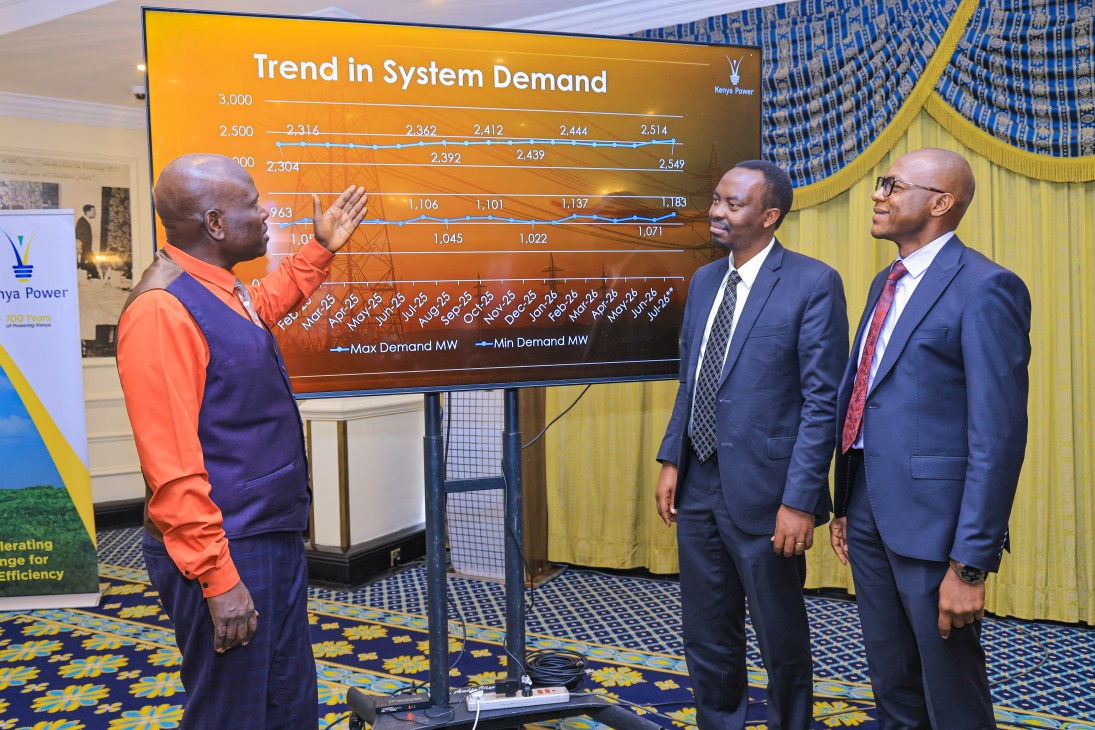
At peak daytime demand of 1,900MW, solar and wind form 34 per cent of Kenya’s energy mix, and 36 per cent during low-load periods of 1,200MW.
That share is well above the recommended threshold and the company says the gap is already exposing the grid to real vulnerability.
“Global benchmarks suggest a limit of 15 per cent of total firm capacity of the grid for VRE,” stated Kenya Power Managing Director and CEO Dr (Eng) Joseph Siror.
He added: “Today, we have a take-or-pay model of power purchase which has resulted in VREs increasing beyond 20 per cent whereas the recommended average is 15 per cent.”
Given the intermittent nature of wind and solar, Kenya Power says the company has no alternative but to dispatch and pay for generators, which increases the overall cost of power in the country.
When wind and solar generation suddenly falls or surges, which happens regularly, Kenya Power is forced to bring in backup generation at additional cost to prevent the grid from failing.
Eventually, the company passes that cost on to consumers in their electricity bills.
The answer is often battery storage, but Siror says that just transfers the problem elsewhere, although for VREs the recommendation is usually battery storage systems.
Modernising dairy plants can cut emissions by up to 49 per cent, new Tetra Pak study finds
However, they would still be challenged on how to charge the batteries when the wind and sun dip and the real cost of VREs is not just their cost but the extra power the firm pays for to stabilise the grid.
“Investments in geothermal and hydro give the grid more stability and make sure it can recover and keep functioning when the intermittent sources are not there,” he said.
Kenya’s dependence on VRE is by far the highest in the region.
In the Eastern Africa Power Pool, Egypt is at 10.4 per cent, Ethiopia at 5.3 per cent, Uganda at 4 per cent and Tanzania at just 1.2 per cent, showing how much Kenya has outstripped its neighbours in variable renewable uptake relative to grid capacity.
Currently, geothermal, hydro, power imports and thermal are Kenya’s baseload, accounting for 80 per cent of the energy mix on the grid.
Kenya Power wants to see this baseload grow further, arguing that these sources are inherently more stable and less prone to sudden swings in production than wind and solar.
A pipeline of new baseload projects is already in motion, including KenGen’s Olkaria I (61MW) and Olkaria VII (80MW), Globeleq Menengai (35MW), Orpower 22 Menengai (35MW), Ethiopian power imports (200MW), the fully drilled Paka Silali geothermal project (100MW) and Nabuyole (28MW).
The raising of the Masinga Dam wall by 1.5 meters is also projected to generate an additional 83GWh annually.
Kenya also eyes a proposed 300MW LNG power plant, the High Grand Falls (700MW) and Karura Falls (90MW) hydro projects further down the line as it seeks to anchor the grid with firmer, more predictable power.