
Stanbic Bank and Safer Power join forces to fast-track Kenya’s clean energy shift

Stanbic Bank Kenya has deepened its commitment to clean energy growth through a renewed Renewable Energy Proposition that aims to make solar power more affordable and accessible for homes and enterprises across the country.
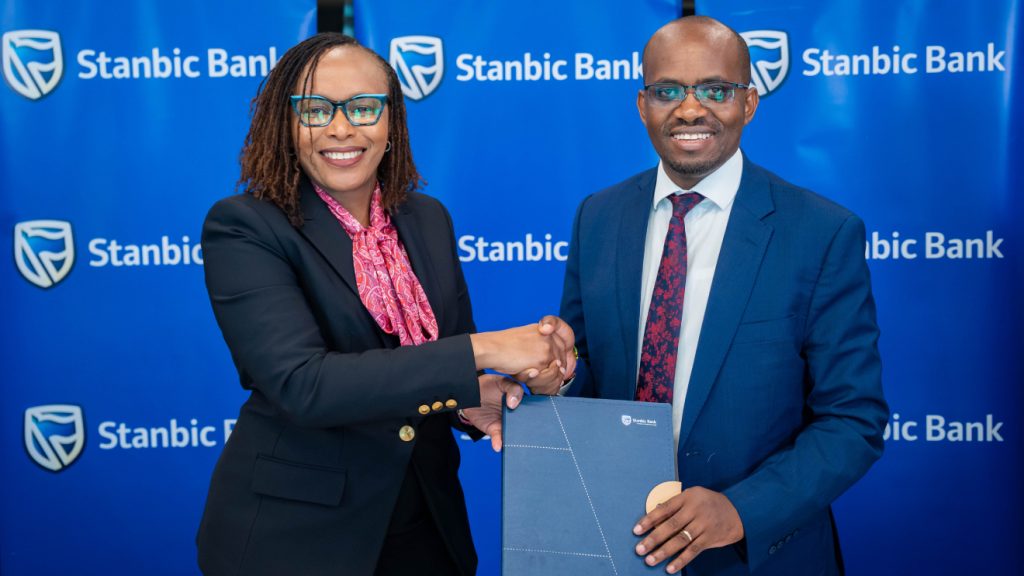
The announcement came during the signing of a Memorandum of Understanding with Safer Power Limited, an Engineering, Procurement, and Construction (EPC) firm specialising in renewable energy projects.
The two organisations will now work together to provide tailored financial and technical solutions that promote the shift toward sustainable power.
While unveiling the partnership, Florence Wanja, Regional Head for Business and Commercial Banking in East Africa at Stanbic Bank, noted that clean energy remains a core focus for the institution’s operations.
“Renewable energy is a strategic priority for Stanbic Bank as part of our purpose ‘Kenya is our home, we drive her growth.’ We recognise that access to affordable and sustainable power is essential for Kenya’s economic development,” Wanja stated.
Wanja explained that the Bank had refined its renewable energy solutions to better accommodate clients seeking long-term financing.
“We have redesigned our renewable energy offering to give clients more flexibility, affordability, and access to clean energy,” she said.
“With extended loan tenors of up to ten years, bank financing of up to 100 per cent and a moratorium on principal repayments during the project development phase, we are making it easier for businesses and individuals to adopt solar energy solutions.”
According to findings from the Kenya Institute for Public Policy Research and Analysis (KIPPRA) and the International Energy Agency (IEA), Kenya had installed about 229 megawatts of solar energy capacity by mid-2024.
The two organisations expect the sector to expand by over 28 per cent every year until 2027, underscoring solar energy’s pivotal role in achieving universal electricity access by 2030.
Under the Bank’s enhanced proposition, small and medium-sized enterprises (SMEs) as well as smaller installations valued at less than Sh6.5 million will enjoy an easier application process.
Instead of submitting full financial statements, qualifying clients will only need to provide account turnover records.
The Bank has also removed the requirement for additional collateral, streamlining the approval process to speed up access to funding.
Stanbic’s partner EPC firms will carry out complementary energy audits to assess customers’ power needs and recommend appropriately sized solar systems.
All installations will rely on high-quality equipment sourced exclusively from Tier 1 manufacturers to guarantee performance and reliability.
To cushion clients against economic pressures, Stanbic has introduced preferential interest rates and waived processing fees for renewable energy loans targeting SMEs.
Safer Power Limited’s Group CEO, Dalmus Mbai, welcomed the collaboration, describing it as a step forward in expanding affordable green power solutions.
“We are driving Kenya’s renewable energy transition by combining innovative technology with accessible and flexible financing,” Mbai said.
The initiative aligns with Stanbic Bank’s long-term sustainability strategy that combines financing, advisory, and technical expertise to advance national clean energy goals and strengthen the country’s self-reliance in power generation.
Some of the notable features of the improved Renewable Energy Proposition include:
▪ Loan repayment periods stretching up to ten years
▪ Full financing coverage for qualifying projects
▪ A moratorium on principal payments during development
▪ Turnover-based lending for SMEs and small-scale systems
▪ No need for additional collateral for eligible clients
▪ Free energy audits through accredited EPC partners
▪ Access to trusted solar technology providers
▪ Competitive interest rates
Wanja reaffirmed the Bank’s goal of encouraging widespread adoption of solar technology.
“With our competitive and flexible renewable energy financing, we aim to accelerate solar adoption and support Kenya’s vision of universal electrification,” she said.
Stanbic’s Business and Commercial Banking clients will also gain access to the Standard Bank Sustainability Academy, a continent-wide training initiative that helps enterprises understand and apply sustainability principles.
The academy offers practical lessons on renewable energy, climate-smart agriculture, water and waste management, and carbon markets—equipping organisations with the tools to embed environmental and social responsibility into their operations.


